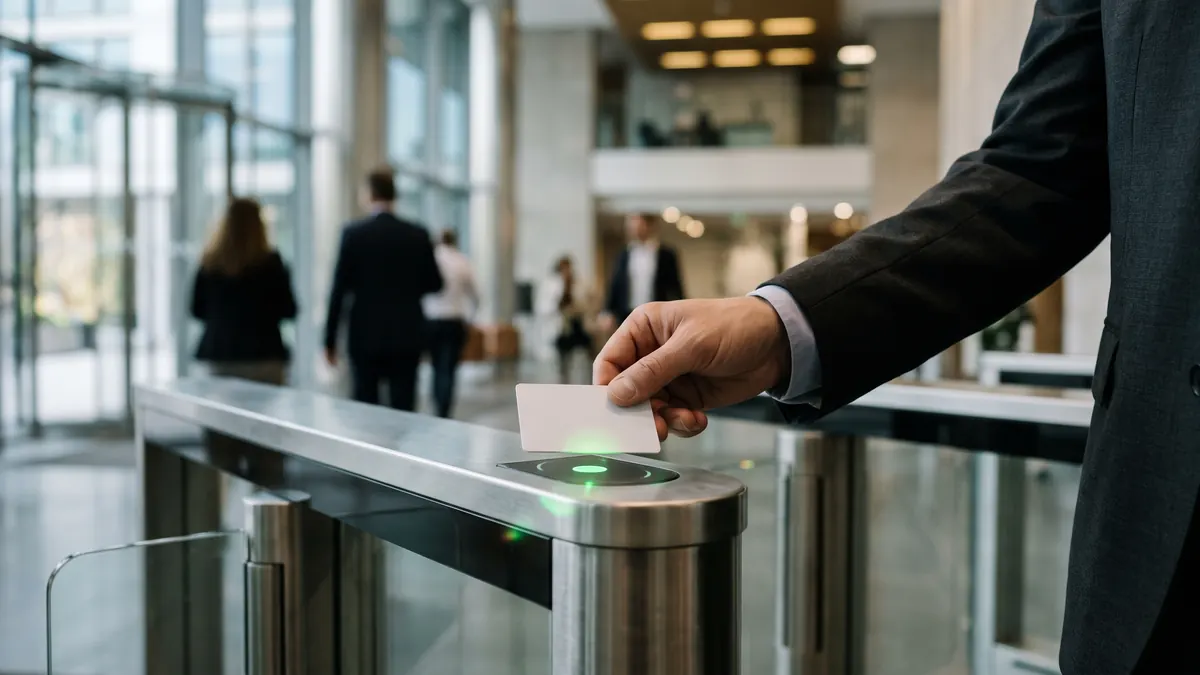
The queue at the entrance is the audience's first contact with the event and often the first point of risk. When people wait too long, pressure builds and the temptation to rush the checks grows. The answer is not to check less, but to plan better.
It all starts with the peak hour
Audiences do not arrive evenly. At most concerts, the majority arrive in the last hour before the headline act. The number of entry lanes is calculated for that peak, not for the evening average:
lanes needed = people arriving in the peak hour ÷ people one lane can check per hour
How fast can the audience get in
The UK Guide to Safety at Sports Grounds (the Green Guide), also used as a reference for other large-audience events, sets an upper limit of 660 people per hour for a single entry point. Real throughput is lower when body or bag searches are carried out, and it depends on staff training, the condition of the entry point and the type of check.
A simplified example: at an event with 8,000 spectators, of whom 60% arrive in the last hour, we are talking about 4,800 people. If a lane with bag checks processes around 400 people an hour, at least 12 lanes need to be open in that window. The exact figures are set for each event, depending on the venue and the type of check.
“A long queue is not solved by officers checking faster, but by more lanes open at the right time.”
What cuts queues without weakening the checks
- Communication before the event. Rules on bag sizes and prohibited items, published on the ticket, the website and social media, reduce the number of people stopped at the check.
- Separate lanes. A fast lane for people without bags and dedicated lanes for those with bags.
- Ticket scanning separate from the search. When the same person scans and searches, both slow down.
- Opening the gates earlier. A longer entry window spreads arrivals and lowers the peak.
- Male and female officers on every lane. Body searches are carried out by someone of the same sex, and a missing officer blocks the lane.
- A well-defined waiting area. Mobile barriers and zig-zag lanes keep order and prevent crushing at the gate.
- Information stewards along the queue. They explain the rules in advance and take people without tickets or with prohibited items out of the line.
What must not be sacrificed
Pressure at the gates does not justify dropping the checks. Romanian Law no. 333/2003 provides that security staff may only allow access under the conditions set by law and internal rules, and the organiser's entry policy becomes part of those rules. When the queue grows, the coordinator opens additional lanes or adjusts the flows; the checks are not reduced.
The exit matters just as much
Access planning also covers the end of the event. At the exit, the flow is far more concentrated than at the entrance, and the gates, corridors and nearby transport stops must be planned so the audience can leave without bottlenecks.